

LATEST NEWS FROM THE ACADEMIC UNIT OF NEUROLOGY
New Study Launches Investigating Neuroelectric Signaling - Dr Lara McManus
A new study investigating the neuroelectric signaling between the brain and motor neurons in ALS is now underway by researchers at Trinity College Dublin. A team led by Dr Lara McManus’s will use non-invasive highdensity surface electromyography (HDsEMG) to identify the firing patterns of individual motor units in the muscle. By analysing signals from both the brain and motor neurons, the team aims to understand how brain-muscle connectivity changes in motor neuron disease.
The team includes Dr Saroj Bista, a postdoctoral researcher whose PhD work found that in people with primary lateral sclerosis, parts of the brain that are not usually active during movement, step in to help perform certain tasks. Two doctoral students, Giuseppina Del Duca and Zuyu Du, have also joined the project. Giuseppina’s research will use HDsEMG to study the properties and behaviour of motor units in people living with ALS, and how these may change over time. A motor unit is a single motor neuron and the muscle fibres it controls, working together to produce movement. Giuseppina will also examine whether differences in motor unit function can help to identify different subtypes of ALS. Zuyu’s work will focus on the relationship between brain and muscle, examining how brain activity influences motor neuron firing in people living with ALS. He will also develop new algorithms to improve the detection of motor unit firings, allowing researchers to more accurately track changes in motor neuron behaviour.
If you would like to find out more information about the study, or if you think you may like to take part, please see www.mcmanuslab.com or contact mcmanuslab@tcd.ie
Exploring How Genetics, Family history and Brain activity influence MND - Dr. Ciara O’Donoghue
Dr. Ciara O’Donoghue is both a practicing doctor who works in the National ALS Service at Beaumont and a PhD researcher, working with Professor Orla Hardiman and Dr. Ross P. Byrne. Her work focuses on Motor Neuron Disease (MND/ALS), with a special interest in how genetics and brain activity might influence the illness. She combines her clinical work with research, aiming to deepen our understanding of ALS and, ultimately, improve care and outcomes for patients.
Dr. Ciara O’Donoghue is both a practicing doctor who works in the National ALS Service at Beaumont and a PhD researcher, working with Professor Orla Hardiman and Dr. Ross P. Byrne. Her work focuses on Motor Neuron Disease (MND/ALS), with a special interest in how genetics and brain activity might influence the illness. She combines her clinical work with research, aiming to deepen our understanding of ALS and, ultimately, improve care and outcomes for patients.
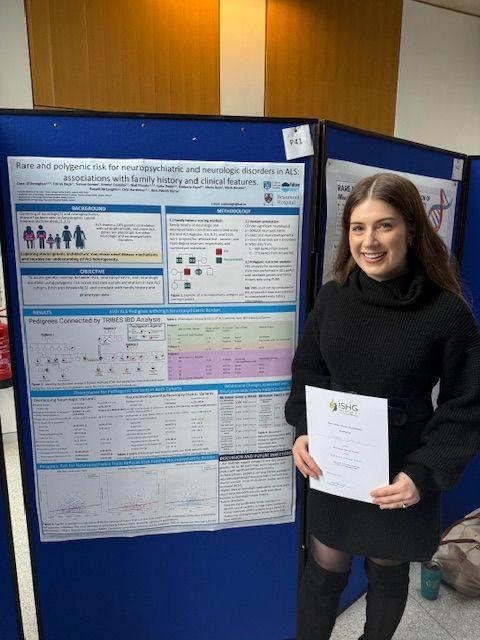
At a recent scientific meeting, Dr. O’Donoghue shared research on how genetic risk for other brain conditions such as mood or psychiatric disorders, and other neurologic disorders might also play a role in ALS. This is important because it suggests that ALS may share some underlying biological pathways with other brain-related conditions.
Dr. O’Donoghue is also exploring extended family trees in ALS. Sometimes, people who believe their ALS is “sporadic” (with no family history) may actually be connected to distant relatives in Ireland who also have ALS. This work could help uncover hidden genetic links or new risk factors, which may
explain why some people develop ALS even if no obvious gene has been identified in their family.
Another part of her research, in collaboration with
Professor Roisin McMackin, looks at brain activity exploring whether people with ALS who carry a higher genetic risk for psychiatric conditions might show unique brain wave patterns compared to others with ALS. If so, this could point to different “subtypes” of ALS, opening doors for more tailored approaches to treatment and care. Together, these projects are helping to piece together the bigger picture of ALS. Understanding how genetics, family history, and brain activity fit into the puzzle could not
only improve diagnosis but also move us closer to more personalized therapies.
Study into the early signs of impaired neural activity in MND - Dr. Gabriel Costa
Dr. Gabriel Costa is a postdoctoral research fellow at Trinity College Dublin studying the early signs of impaired neural activity in MND. In 2023, he was awarded a Marie Sklodowska-Curie COFUND Fellowship to use advanced data analysis methods to further our understanding of neurodegeneration in MND. Under supervision of Professor Orla Hardiman and Professor Bahman Nasseroleslami, his work at the Academic Unit of Neurology, TCD, has shown how distinct signals in the brain waves measured using Electroencephalography (EEG) are
Dr. Gabriel Costa is a postdoctoral research fellow at Trinity College Dublin studying the early signs of impaired neural activity in MND. In 2023, he was awarded a Marie Sklodowska-Curie COFUND Fellowship to use advanced data analysis methods to further our understanding of neurodegeneration in MND. Under supervision of Professor Orla Hardiman and Professor Bahman Nasseroleslami, his work at the Academic Unit of Neurology, TCD, has shown how distinct signals in the brain waves measured using Electroencephalography (EEG) are
altered in MND, indicating the impairment of neural activity. These changes in brain cell activity may reflect ongoing degeneration, but they can also provide new insights into the mechanisms driving the disease.
To better understand the origin of these altered brain signals, Dr. Costa is combining EEG findings with detailed brain maps that chart the molecular and cellular characteristics of different regions of the human brain. This approach helps identify which neurons and brain areas are most likely responsible for the differences observed in EEG. His recent work, presented at the ENCALS 2025 Conference in Turin, Italy, highlighted how particular neurotransmitters, the chemical messengers that neurons use to communicate, are linked to the EEG changes seen in MND. For this contribution, he was awarded a Best Poster prize at the conference.
To better understand the origin of these altered brain signals, Dr. Costa is combining EEG findings with detailed brain maps that chart the molecular and cellular characteristics of different regions of the human brain. This approach helps identify which neurons and brain areas are most likely responsible for the differences observed in EEG. His recent work, presented at the ENCALS 2025 Conference in Turin, Italy, highlighted how particular neurotransmitters, the chemical messengers that neurons use to communicate, are linked to the EEG changes seen in MND. For this contribution, he was awarded a Best Poster prize at the conference.
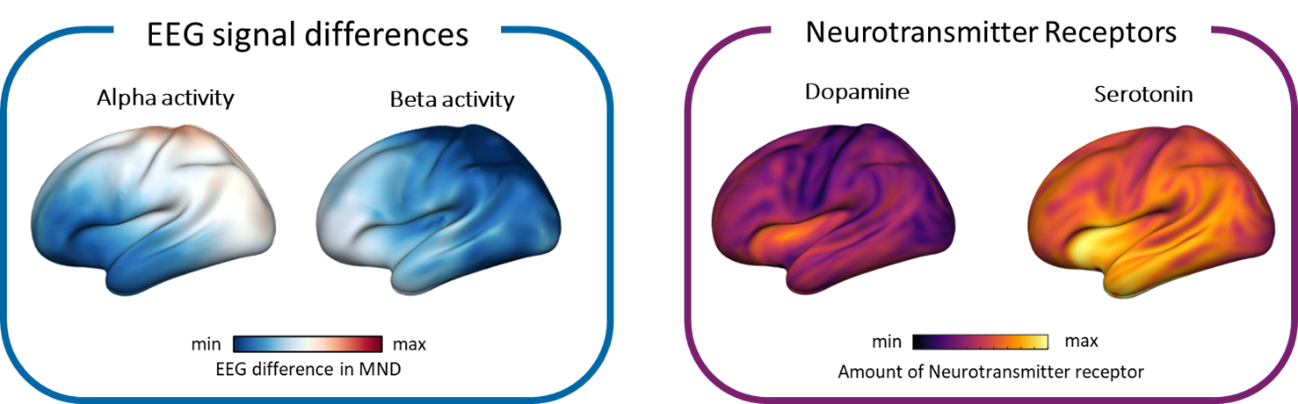
Figure 1. Left: Differences in EEG activity of distinct brain waves. Distribution of different neurotransmitters in the healthy brain. Right: The association of both types of brain maps, EEG activity and neurotransmitters, can help us understand the origins of impaired neural activity in MND.
PRECISION ALS: An Irish-Led Innovative Collaboration across Research Active European Sites.
MND is a rare disease, it is vital that we have sufficient scale to allow us to make meaningful discoveries. Trinity College Dublin, along with the TRICALS (Treatment Initiative to Cure ALS) are working together to collect information from thousands of MND patients across Europe. The PRECISION ALS project is funded by Research Ireland, in collaboration with industry partners. The TRICALS Consortium is co chaired by Prof. Orla Hardiman (Trinity College and Beaumont Hospital Dublin) and Prof. Leonard van den Berg (University of Utrecht, Netherlands).18 sites across 15 countries are now working closely together to collect prospective longitudinal data from as many people with MND as possible. The objective is to collect all aspects of the disease from the time of diagnosis through the entire patient journey, to understand all aspects of the condition.
PRECISION ALS will also develop and utilise new technologies and devices to better understand differences in how the disease develops in different subgroups. As data are collected and collated using a bespoke patient platform designed by data scientists in Trinity College Dublin, the large dataset will help to drive development of new AI and machine learning techniques, enhancing the potential for discovery of different subtypes of disease, and development of better therapies, so that we will eventually be able to provide the right drug for the right patient at the right time.
If you would like more information on PRECISION ALS you can visit www.precisionals.ie
MND is a rare disease, it is vital that we have sufficient scale to allow us to make meaningful discoveries. Trinity College Dublin, along with the TRICALS (Treatment Initiative to Cure ALS) are working together to collect information from thousands of MND patients across Europe. The PRECISION ALS project is funded by Research Ireland, in collaboration with industry partners. The TRICALS Consortium is co chaired by Prof. Orla Hardiman (Trinity College and Beaumont Hospital Dublin) and Prof. Leonard van den Berg (University of Utrecht, Netherlands).18 sites across 15 countries are now working closely together to collect prospective longitudinal data from as many people with MND as possible. The objective is to collect all aspects of the disease from the time of diagnosis through the entire patient journey, to understand all aspects of the condition.
PRECISION ALS will also develop and utilise new technologies and devices to better understand differences in how the disease develops in different subgroups. As data are collected and collated using a bespoke patient platform designed by data scientists in Trinity College Dublin, the large dataset will help to drive development of new AI and machine learning techniques, enhancing the potential for discovery of different subtypes of disease, and development of better therapies, so that we will eventually be able to provide the right drug for the right patient at the right time.
If you would like more information on PRECISION ALS you can visit www.precisionals.ie

